
Industries
Purpose-built AI systems for the industries we serve.
Not sure where to start?
Talk to our team


AI-native search that understands natural language and delivers direct answers
Multi-tenant AI CRM with a per-industry module architecture — each new industry gets a tailored feature set on shared infrastructure
AI orchestration layer coordinating agent workflows across CRMs, email, and marketing tools
Try Zunkiree Search Free
See how AI search delivers direct answers instead of links. Transform your customer experience.
Start free trialReady to build with AI?
Schedule a callState of AI in Nepal 2026
The definitive guide to AI adoption across Nepali industries. Free download.
Download reportReady to build with AI?
Schedule a callNepali Language AI: Building Chatbots & Search in Nepali
Technical guide to NLP for the Nepali language
Related Resources
The challenge of Nepali NLP
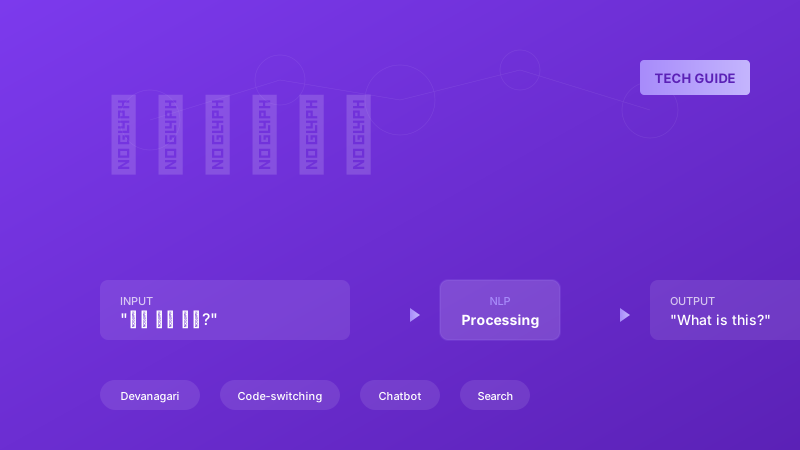
Building AI systems that understand Nepali presents unique challenges. Nepali is a low-resource language with limited training data compared to English or Chinese. The Devanagari script has complex character combinations. And users naturally mix Nepali and English in queries (code-switching).
This guide covers practical solutions for these challenges, drawing on our experience building AI systems for the Nepal market. Whether you're creating chatbots, search systems, or document processing pipelines, this technical guide will help you navigate the complexities of Nepali NLP.
Key challenges we address
Devanagari script handling
Unicode normalization, character combinations (संयुक्ताक्षर), and text preprocessing for ML pipelines.
Code-switching detection
Handling queries like "yo product ko price kati ho?" that mix Nepali and English in the same sentence.
Low-resource language strategies
Transfer learning from Hindi, multilingual models, and data augmentation techniques.
Tokenization and embeddings
Word segmentation, subword tokenization, and creating embeddings for Nepali text.
What you get:
Frequently asked questions
Yes, modern LLMs have some Nepali capability, but performance varies. We cover prompt engineering techniques specific to Nepali, when to use LLMs vs. specialized models, and how to evaluate Nepali language performance.
The guide covers available Nepali datasets (newspapers, Wikipedia, social media), data augmentation strategies, and how to create your own training data efficiently.
Primarily practitioners. We focus on production-ready solutions rather than academic exploration. That said, we reference relevant research and provide pointers for those who want to go deeper.